
Book review of Lilliput Land by Prof Rama Bijapurkar
Indian consumer market is as heterogenous as it is large – to win in this unique mid-income, high-aspiration market, craft a unique India strategy
In the three years that I worked with a Union Minister, at many business events I would often hear him beseech his audience to “deliver your product/service at a price that works in Jhanda Chowk, Hazaribagh; India does not operate on the price points of Times Square or Hyde Park. And if you can do this, this opens the market for the next six billion.” While I did not study under Prof Rama Bijapurkar at IIM Ahmedabad, I notice the same refrain in her latest book, Lilliput Land – How Small is Driving India’s Mega Consumption Theory. She challenges those who want a large pie of the India consumption story to “offer consumer-perceived delight at consumer-affordable prices and still be profitable.”
A key premise of this book is that incomes, expenses, and especially savings, are concentrated in India-1, a small sliver of the population. However, in what gives the book its title, many, many Lilliputian segments exist with their own specific wants and ability to pay. To drive the future of India’s mega consumption story what is needed is: “large platforms comprising myriads of small consumers and suppliers digitally yoked together.” This makes India a sui generis market which requires its own unique strategy. In the world of asset allocation, we would say that India is an asset class of its own.
I had, in April 2012, while working for a sell-side firm developed a model of how Indian consumption could evolve (“Metamorph: The India Consumption Story). It has six income-based buckets and projected how the number of households in such segments could evolve. The segments had a catchy name: RUPEES – Real rich, Upper class, Prospering, Evolving, Emerging, and Surviving. This may now not meet the approval of the professor who would call it “sirf angrezi.” She rightly points out that income is only one of determinants of consumption; education, source of income, location, “culture classes” are also important factors. I can note with some academic satisfaction that my thesis then – that the Middle Class was a great Indian myth and may continue to remain so – still holds.
As analysts of Indian economy and its consumer base, we need to devise a new terminology for Middle Class. The connotation that middle class evokes is of a median household (or the 150 millionth household in a country of ~300 million households). In her various articles and this book, the author talks of the concept of resilience when thinking of the middle class: the ability to survive at least one economic shock (temporary loss of job, illness, accident, natural disaster, etc.) without material, long-term impact on consumption. This, as she notes, constitutes only a small fraction of the population: largely the top decile or two (so the top 30 million to 60 million households). Possibly, we should call it the Resilient Class to better describe it.
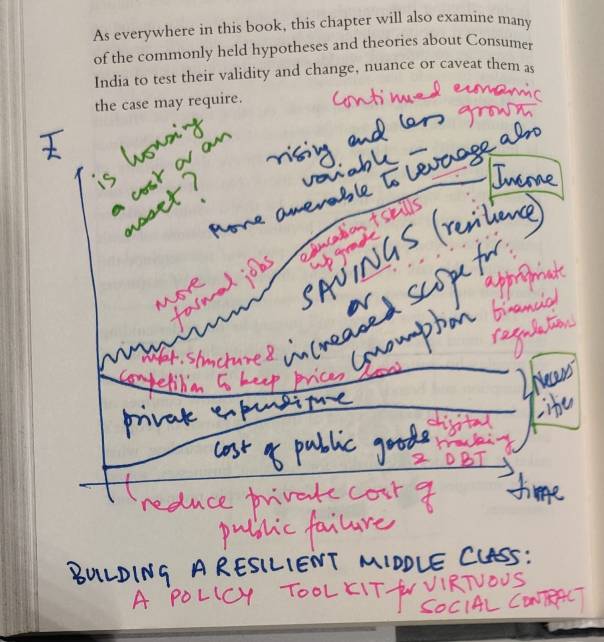
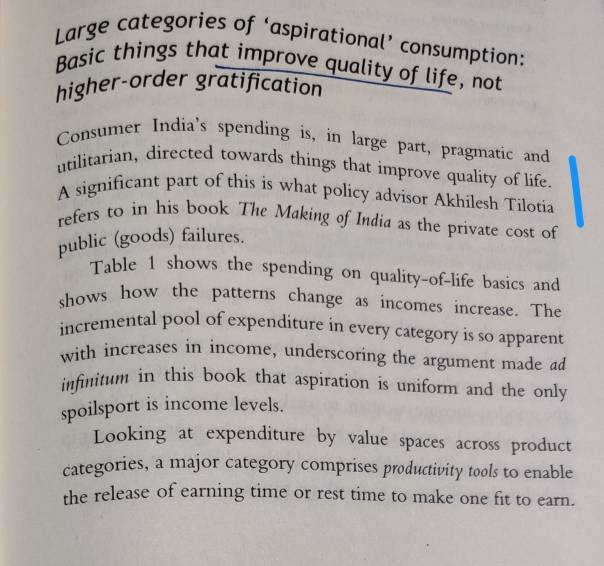
The author uses the physics formula of f=ma (force equals mass multiplied by acceleration): to gain momentum ‘f’ in the Indian market focus on ‘m’ (the sheer mass of consumers) rather than on ‘a’ (high price points to protect globally mandated margins). Her “mental model”, as applied for the consumer market, is fascinating for me as I use this same framework to think about public policy. A small change in government policy can unlock momentous changes given the sheer mass that such policies impact. In that vein, the public policy aim should be to build the Resilient Class: that comes from widely dispersed stable jobs with growing incomes and a contained cost of living (specifically, reducing the private cost of public failures).
This book is a treasure trove of data on the various cuts that shape India’s consumers. There are few good, long-term consistent data sets on Indian demographics that speak with each other. Indeed, the author herself has, through her career, helped establish many of these data sets. A few analyses and implications stood out for me: (1) 68% of the annual savings in the country is with the richest 10%, and the bottom 60% cumulatively have no annual savings, (2) if you are a graduate or higher educated, not surprisingly, you stand a better chance to be richer; and (3) while urban India currently offers a chance for higher incomes and higher savings, with physical and digital connectivity improving, we may end up with a rural-urban continuum rather than a divide. [My annual road trips can attest to this!]
It is not just “gory” data. Read this book if you want some interesting anecdotes. Fortune 100 CEOs and their global boards coming to India to the watchman who oversees everything and possibly gossips to everyone – they all feature here. In the final section, the author does a fantastic job of cutting to the chase of the strategies of the various companies (MNCs and locals) that have been successful or not in India. Sometimes a data point thrown casually is just so enlightening: India consumes a trillion rotis a year!
The main mantra of the book is incontestable and timeless: deliver value at a price point that delights customers while making profits to unlock a goldmine. A large part of this value delivery (or, core business model of successful new economy mass market players) is predicated on the innovations unleased by the lower cost digital aggregation of consumers and suppliers, enabling sharing, and digitalizing processes. India is unique in creating a Digital Public Infrastructure (DPI) – this means that these advantages will largely get socialized. Building a sustainable business model will require taking on the challenge of product and process innovation that gets the consumer in Jhanda Chowk excited.
The question for investors is: in a Lilliput Land, how many unicorns can there be?
The author is a public policy analyst. Views are personal.
PS1: This post triggered a thought on the policy framework for building a resilient middle class. More on that later.
PS2: It is fantastic to be quoted in the book! What can bring more joy to a student when a teacher references his work…thank you!

Hi Alok, thanks for such a detailed review. I have one question though: Does the book talk about different business case studies on why they are working or not in India? Or the book is more about insights and behaviour and it is left to readers to their imagination to figure out businesses?
Thank you for the comment. There is an entire section on the new business models that are emerging. The frameworks on where and what the customer segments are can be helpful in deciding on a business model.